 ToolClover
On this page
- How to use
- Wording you can copy
- Example signs
- Shortage sign vs. rounding sign
- Checklist
- Where to post it
- Is a sign required?
- Printing tips
- FAQ
- Sources
How to make a penny rounding sign
- Pick a headline. "Cash totals are rounded to the nearest 5¢" says the rule outright. "We're out of pennies" or "We're short on pennies" work as penny shortage sign wording. You can also write your own.
- Choose the rounding rule your register uses: nearest 5¢ (symmetrical) or always round down. The sign's wording and table follow your choice.
- Choose the language. Bilingual signs show English first with the Spanish below it.
- Pick a size. Full page for a door or wall, half page for beside the register, or 4.25 × 5.5 in counter cards for a 5 × 7 in sign holder.
- Select Print sign, or save it as a PDF to print later or send to a print shop.
Want a staff chart of every cent behind the counter? Print it on the same paper and keep it by the till.
Penny rounding sign wording you can copy
Each set below has a headline, a line of body text and a footer. You can make most of them in the generator by picking the same headline, rule and language, or copy the words onto a handwritten sign. Use the wording that matches the rule your register actually uses.
A. Rounded to the nearest 5¢
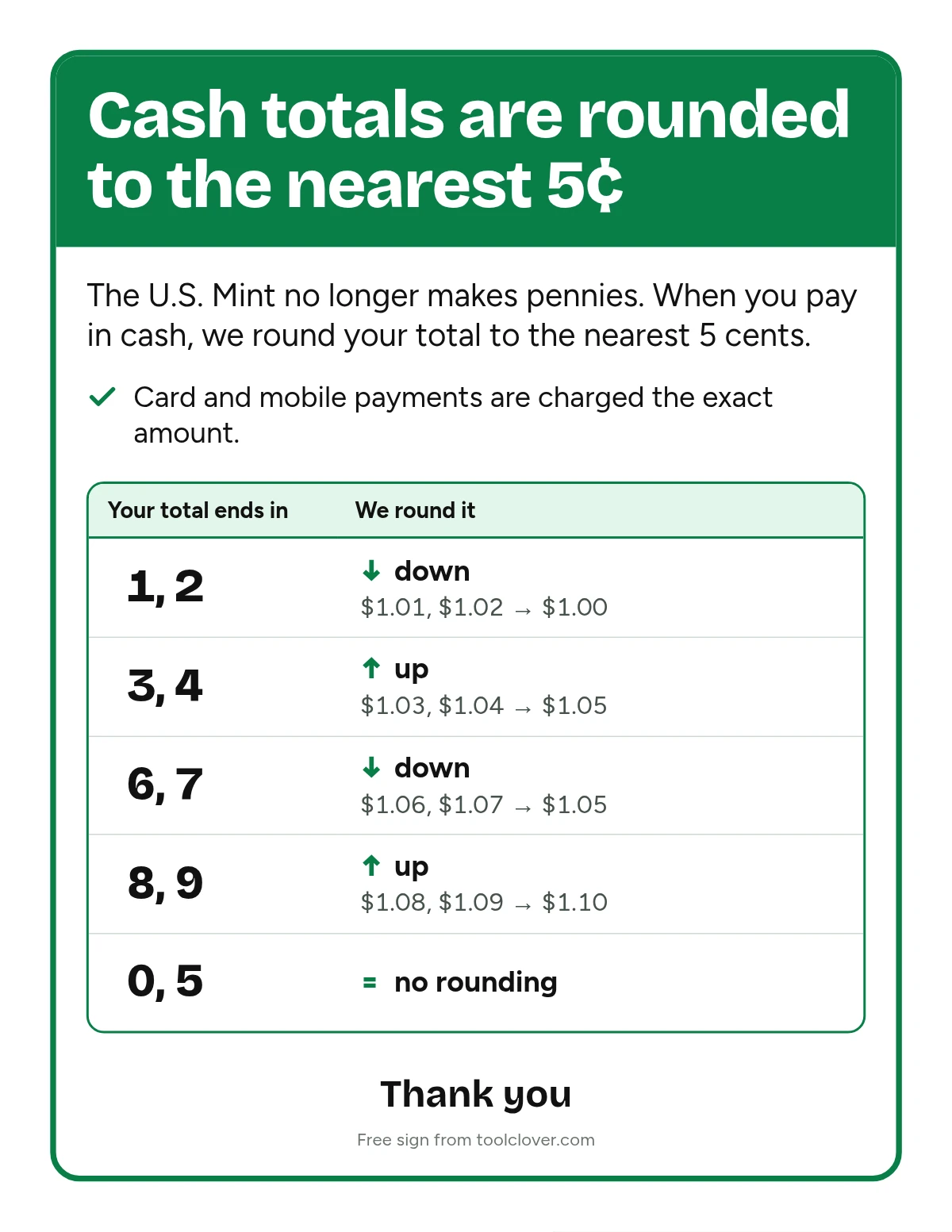
- Headline: Cash totals are rounded to the nearest 5¢
- Body: The U.S. Mint no longer makes pennies. When you pay in cash, we round your total to the nearest 5 cents. Totals ending in 1, 2, 6 or 7 round down; totals ending in 3, 4, 8 or 9 round up.
- Footer: Card and mobile payments are charged the exact amount.
Good for: most shops and cafés that want the rule stated plainly at every register.
B. We're out of pennies
- Headline: We're out of pennies
- Body: We can't give pennies in change, so cash totals are rounded to the nearest 5 cents.
- Footer: Paying with exact change, including pennies? You pay the exact total. Card and mobile payments are charged the exact amount.
Good for: stores that have simply run out of pennies and want an everyday explanation first.
C. Penny rounding in effect
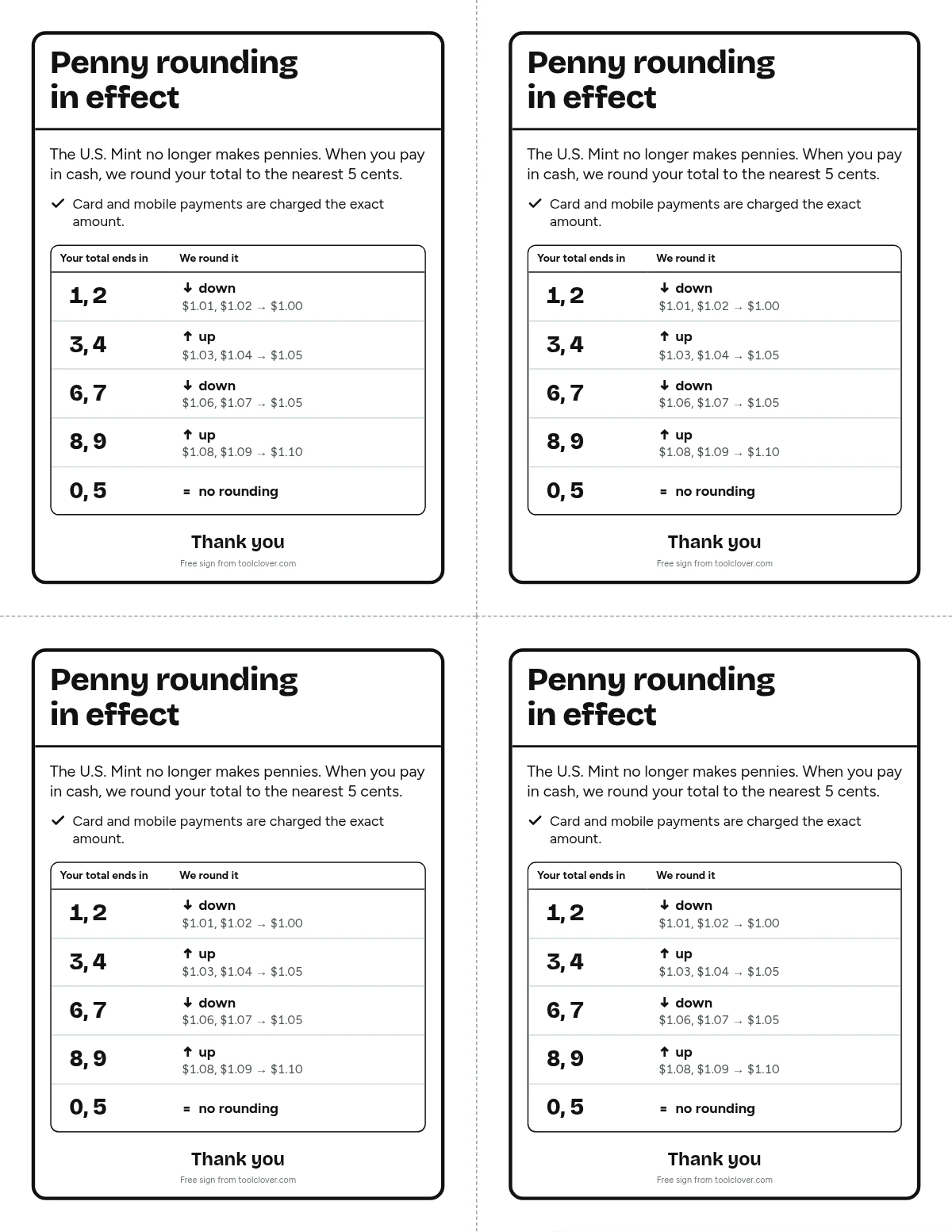
- Headline: Penny rounding in effect
- Body: Cash totals are rounded to the nearest 5 cents after tax. Sales tax is figured on the exact total, before rounding.
- Footer: Card and mobile payments are charged the exact amount. Questions? Ask a cashier.
Good for: grocery stores, pharmacies and other places where customers watch the tax line on the receipt.
D. We round cash totals down
- Headline: We round cash totals down – you never pay more
- Body: The U.S. Mint no longer makes pennies. When you pay in cash, we round your total down to the nearest 5 cents, in your favor.
- Footer: Card and mobile payments are charged the exact amount.
Good for: small shops that want to reassure regulars, and stores that have chosen round-down. Use it only if your register really rounds every cash total down.
E. Spanish only: nearest 5¢
- Headline: Los totales en efectivo se redondean a los 5¢ más cercanos
- Body: La Casa de la Moneda de EE. UU. ya no fabrica monedas de 1¢. Si paga en efectivo, redondeamos su total a los 5 centavos más cercanos. Si su total termina en 1, 2, 6 o 7, lo redondeamos hacia abajo; si termina en 3, 4, 8 o 9, lo redondeamos hacia arriba.
- Footer: Los pagos con tarjeta o con el celular se cobran por el monto exacto.
Good for: hanging next to an English sign when you want large type in both languages, or businesses where most customers read Spanish.
F. English + Spanish: short on pennies
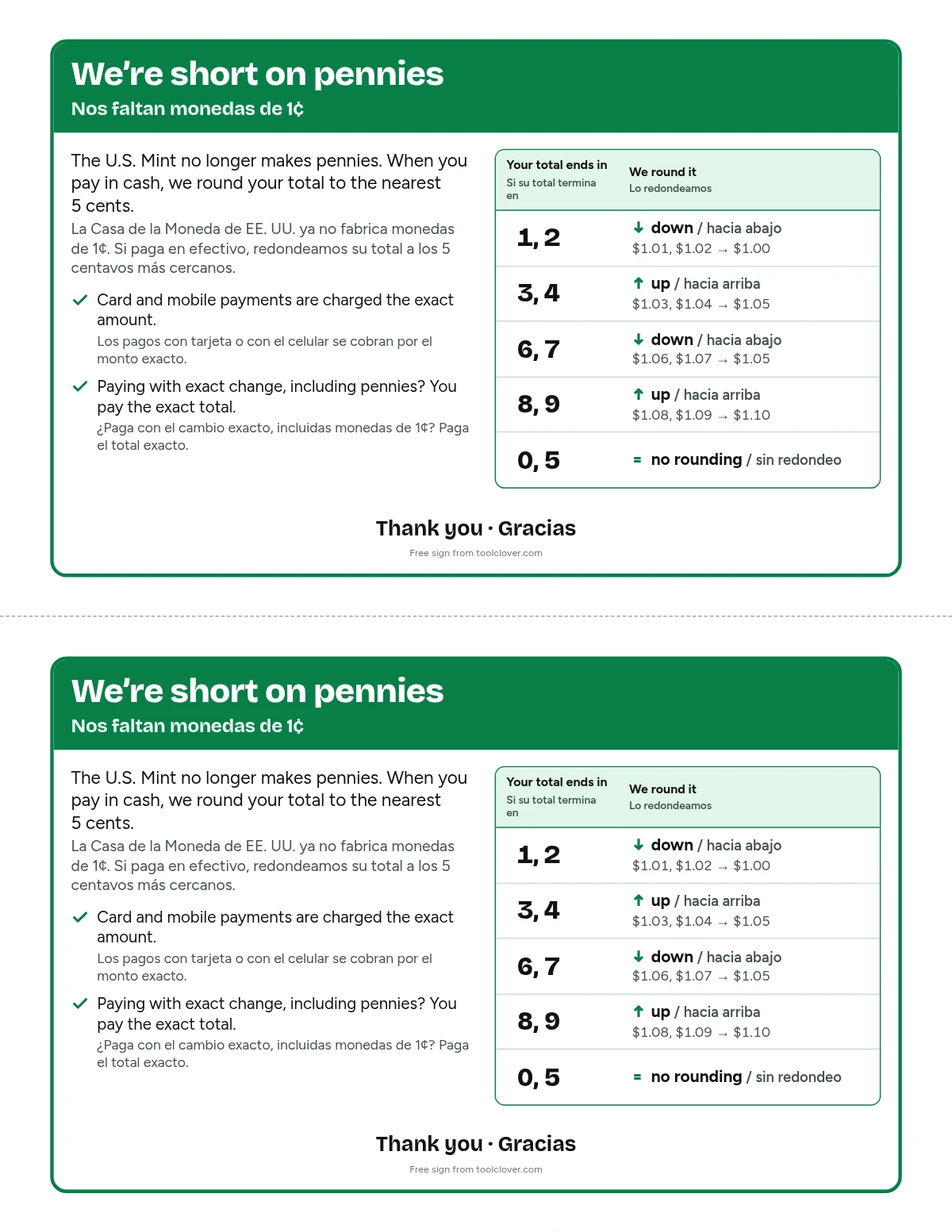
- Headline: We're short on pennies / Nos faltan monedas de 1¢
- Body: When you pay in cash, we round your total to the nearest 5 cents. / Si paga en efectivo, redondeamos su total a los 5 centavos más cercanos.
- Footer: Paying with exact change, including pennies? You pay the exact total. / ¿Paga con el cambio exacto, incluidas monedas de 1¢? Paga el total exacto.
Good for: bilingual neighborhoods and counters where one sign has to serve everyone.
Spanish wording: have a Spanish-speaking staff member read it before you print a batch.
Example signs
These are printed from the generator with the settings shown in each caption.
Penny shortage sign vs. penny rounding sign
Stores looking for penny rounding signage and stores looking for a penny shortage sign often want the same printable PDF, with different wording at the top:
- Penny rounding sign leads with the rule: "Cash totals are rounded to the nearest 5¢" or "Penny rounding in effect." Use this when customers already know pennies are scarce and you want the math clear.
- Penny shortage sign leads with the reason: "We're out of pennies" or "We're short on pennies." Use this when you want a friendlier, everyday explanation before you show how the total rounds.
Both options still explain nearest 5¢ or round-down, show the ending-digit table, and note that card and mobile payments stay exact. Pick the headline that matches how you talk to customers, then print the sign or save it as a PDF for every register.
Before you print: a penny rounding sign checklist
Run through this before you print one for every register:
- The rule matches your register. Ring a cash test sale and check that the POS rounds the way the sign says, nearest 5¢ or always down.
- It says cash only. Keep the card note on so customers know card, mobile and check payments are charged the exact amount.
- Exact change is covered, if you take pennies. Treasury guidance says pennies remain legal tender. If you still accept them, turn on the "exact change" line.
- The tax line is there if customers ask about it. "Sales tax is figured on the exact total, before rounding" is optional, but it heads off questions about the receipt.
- The headline is readable from where customers stand. Print one and check it from the line, not from behind the counter. If it's hard to read, use a bigger size or move it closer.
- Spanish has been checked. If you print a Spanish or bilingual sign, have a Spanish speaker read it first.
- There's one at every register. A sign on the entrance door is optional and works well as a second copy.
- Required wording is on it. If your state sets the exact words, add them in the Extra line box. See "Do you need a sign?" below.
For the rule itself and how tax fits in, see how penny rounding works.
Where to post it, by type of business
- Retail registers: a half-page sign beside each register or cash drawer, facing the customer. Add a full-page copy at the entrance if you want people to know before they reach the line.
- Restaurants and cafés: put it where people pay, at the order counter or host stand, not only by the kitchen pass. A counter card beside the card reader works well.
- Drive-thru windows: tape a half-page sign facing out at the pay window, where the driver sees it before handing over cash.
- Food trucks, market stalls and pop-ups: use a counter card in a 5 × 7 in sign holder at the spot where you take money. Outdoors, laminate it or use a sheet protector.
- Self-checkouts that take cash: if the machine rounds cash totals, put a counter card next to the cash slot so customers know before they insert bills.
- Laundromats and service counters: post it at the attendant counter where cash changes hands. Coin-only machines don't need one.
Do you need a sign?
Arizona requires businesses that have no pennies at the point of sale to round cash totals to the nearest 5 cents and to post a visible notice at the point of sale. The Arizona Department of Revenue gives the wording: "Cash transactions are rounded to the nearest five-cent increment pursuant to state law." To put that sentence on your sign word for word, type it in the Extra line box.
Some other states, including Oregon and Vermont, also require businesses that round to post a notice, and Vermont's law refers to a notice created by the state. Requirements and wording differ, so check your state's rule before you print. Even where a sign isn't required, posting one tells customers the rule before they pay, which saves arguments at the register.
A note on rounding up: this generator doesn't make "always round up" signs. Most state laws describe symmetrical rounding, and cash-discrimination rules in some states and cities bar charging cash customers more than card customers. Connecticut guidance, for example, has said its cash-discrimination law bars rounding cash totals up until its rounding law takes effect on January 1, 2027.
Laws are changing quickly. This is general information, not legal or tax advice. Check your state revenue department for current rules.
Printing tips
- Paper and scale: choose US Letter and 100% (or "Default"). Don't use "Fit to page", which shrinks the margins unevenly.
- Headers and footers: turn them off in the print window's "More settings" so the date and web address don't print on the sign.
- Colors: if the colored band doesn't print, turn on "Background graphics". Or choose Ink saver, which prints in black on white.
- Half page and counter cards: cut along the dashed lines. A counter card is 4.25 × 5.5 in and fits a 5 × 7 in sign holder.
- On a phone: open your browser's Share or menu button and choose Print. Most phones can save a PDF from there.
Penny rounding in Spanish: bilingual sign template
Set Language to Spanish for a sign written entirely in Spanish, or to English + Spanish for a bilingual penny rounding sign template with the English wording first and the Spanish below it. The rule table, the card-payment note and the optional "exact change" line are translated too, so customers who read either language see the same rule.
- Headline in Spanish: "Los totales en efectivo se redondean a los 5¢ más cercanos" (cash totals are rounded to the nearest 5¢).
- Card note: "Los pagos con tarjeta se cobran por el monto exacto" (card payments are charged the exact amount).
- Which to pick: a bilingual sign suits most registers. Use a Spanish-only sign beside an English one when you want large type in both languages.
Wording on the bilingual sign follows the rule you choose, nearest 5¢ or always round down. Have a Spanish-speaking staff member read the sign before you print a batch, especially if you write your own headline.
Penny rounding sign FAQ
Do I have to post a penny rounding sign?
In Arizona, yes: businesses that round cash totals because they have no pennies must post a notice at the point of sale (Arizona DOR). Other states' laws and guidance differ, so check with your state revenue department. Even where it isn't required, a sign at the register tells customers the rule before they pay.
Why can't I make a sign that says we always round up?
Most state rounding laws describe symmetrical rounding, and cash-discrimination rules in some states and cities bar charging cash customers more than card customers (Holland & Knight). The generator offers nearest 5 cents and always round down, the two rules you can post with the least risk.
What is the difference between a penny shortage sign and penny rounding signage?
A penny shortage sign leads with "We're out of pennies" or "We're short on pennies." Penny rounding signage leads with the rounding rule itself. Both can be the same printable PDF; only the headline changes. This generator offers both wording options.
Is the penny rounding sign printable for free, and how do I save it as a PDF?
Yes, it is free to print with no account or sign-up. A small toolclover.com credit line is on by default and you can turn it off. To save a PDF, select Print sign, then choose Save as PDF (or Microsoft Print to PDF) as the printer. Set the paper to US Letter and the scale to 100% or Default, and turn off headers and footers.
Where should I post a penny rounding sign?
Put it where customers see it before they pay: beside each register or cash drawer, and optionally on the entrance door. The half-page size suits a counter, and the 4.25 x 5.5 in counter card fits a 5 x 7 in sign holder.
Can I make a penny rounding sign in Spanish?
Yes. Set Language to Spanish for a Spanish-only sign, or English + Spanish for a bilingual sign with English first. The rule table and the card-payment note are translated as well, and the sign is free to print or save as a PDF.
How big should the text on a penny rounding sign be?
Big enough to read from where customers wait, not just from the counter. Use the full page for a wall or door, and the half page or counter card at the register. A counter sign is usually read from about arm's length to 2 meters (6 feet) away, so print one, stand back that far, and check the headline before you print a batch.
Can I put my store logo on the sign?
The generator adds your business name at the bottom of the sign, but not a logo. If you need one, save the sign as a PDF and have a print shop add it, or put a logo sticker on the printed sign.
Should I put up a sign if I still have some pennies?
Yes. Choose the "Short on pennies" headline and turn on the exact change line. Customers then know that paying the exact total, pennies included, is still fine, and that other cash totals are rounded.
Can I use the same sign for a food truck or a market stall?
Yes. Print the counter card size, which is 4.25 × 5.5 in and fits a 5 × 7 in sign holder. Outdoors, laminate it or use a sheet protector, and weigh the holder down so it doesn't blow over.
Sources
- Arizona Department of Revenue – Cash Transaction Rounding Law
- U.S. Treasury – Penny Production Cessation FAQs
- USPS – Penny-rounding policy
- Streamlined Sales Tax – Penny Elimination
- Holland & Knight – States Respond to Penny Pinching with Rounding Legislation (Aug 2026)
- Oregon Legislature – Enrolled HB 4178
- Vermont JFO – S.327 (Act 128) as enacted
Last reviewed: September 2026. Spotted something out of date? Let us know.